News
, In Action
06 / 16 / 2026
Mulo Vélo-Cargo: Riding a Wave of Success!
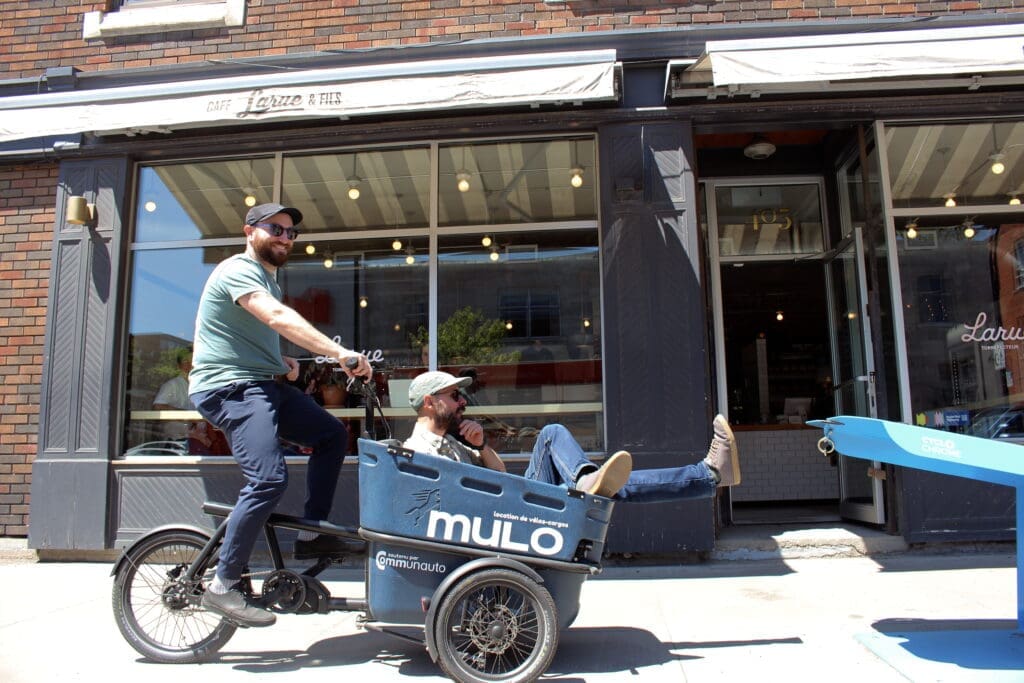
Don’t be surprised if you spot them parked in front of the Jean-Talon Market or spinning down the Réseau express vélo (REV). Montreal recently welcomed its very first self-service electric cargo bikes, created by Mulo, a booming active mobility non-profit which simplifies life for Montrealers while moving the city closer to a low-carbon future!
Michael, Louis-Philippe, and Simon have every reason to be proud, truly proud. In the heart of spring 2026, the small team behind Mulo Vélo-Cargo has just conquered new Montreal boroughs. Fourteen electric cargo bikes, capable of hauling loads up to 150 kg, are now available for self-service in the Villeray–Saint-Michel–Parc-Extension, Rosemont–La Petite-Patrie, and Le Plateau-Mont-Royal boroughs, and will soon arrive in Outremont.
To mark the launch of Mulo Vélo-Cargo’s second season, we met up with its founders at Café Larue on Jarry Street. From inside the shop, we watched the novelty effect of the Mulo bike firsthand: parked at its docking station, it consistently caught the eye of curious passersby. “We wanted to democratize cargo biking and spark interest in this mode of transportation,” says Louis-Philippe. “It’s wonderful to see the curiosity and the conversations it sparks between strangers.”
It has only been a year since Mulo rolled out in the city, backed by early-stage financial support from the Greater Montreal Climate Fund. Yet, the solution is winning over users and already proving its worth, with 1,333 registered members, 226 recorded rentals, 1,317 kilometers traveled, and nearly 295 kg of greenhouse gas emissions avoided to date. As for how they are used, Montrealers are as varied as they are inventive. People rent a Mulo to move apartments, drop the kids off at daycare, take the dog to the vet, bring home groceries from the market, or haul work equipment. In short, Mulo is for all those daily tasks people wouldn’t attempt on a standard bicycle.
“In Copenhagen, nearly one in three families owns a cargo bike,” says Louis-Philippe. While working in Europe on active mobility issues, he and Michael first discovered this mode of transport as users and were soon dreaming of bringing the idea back home. Together with their partner, Simon, they turned their vision into reality in 2025: anchoring a sustainable mobility solution that reshapes how Montrealers get around.
In many ways, it’s safe to say mission accomplished. “What we offer with Mulo are the benefits of a bike combined with the benefits of a car,” Michael sums up, pointing to the agility of the former and the convenience of the latter. In addition to offering a low-carbon alternative that respects planetary boundaries, Mulo Vélo-Cargo provides citizens with a practical, enjoyable, and safe way to commute and experience their city.
Looking back at the past year, the co-founders say they are particularly proud of the strength of the network rallied around Mulo Vélo-Cargo: “In the beginning, it was just us and the Greater Montreal Climate Fund,” Michaelpoints out. “Today, we have numerous partners, including major players like Communauto and Transit.” For Louis-Philippe, nothing beats the pride of seeing Mulos cruising down the streets—the pride of “contributing to a collective effort to improve society with something that truly works for people,” he concludes.
One thing is certain: Mulo Vélo-Cargo has wind in its sails. The Greater Montreal Climate Fund couldn’t be prouder to be part of their journey!
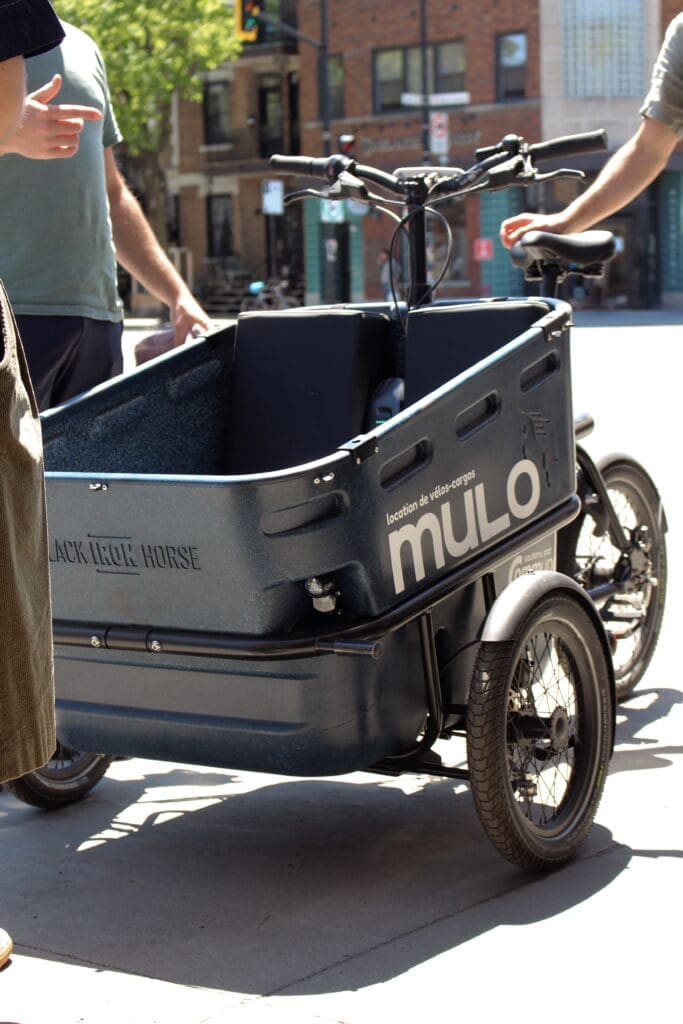
14
electric cargo bikes, capable of hauling loads up to 150 kg

100 %
recycled materials for the transit box
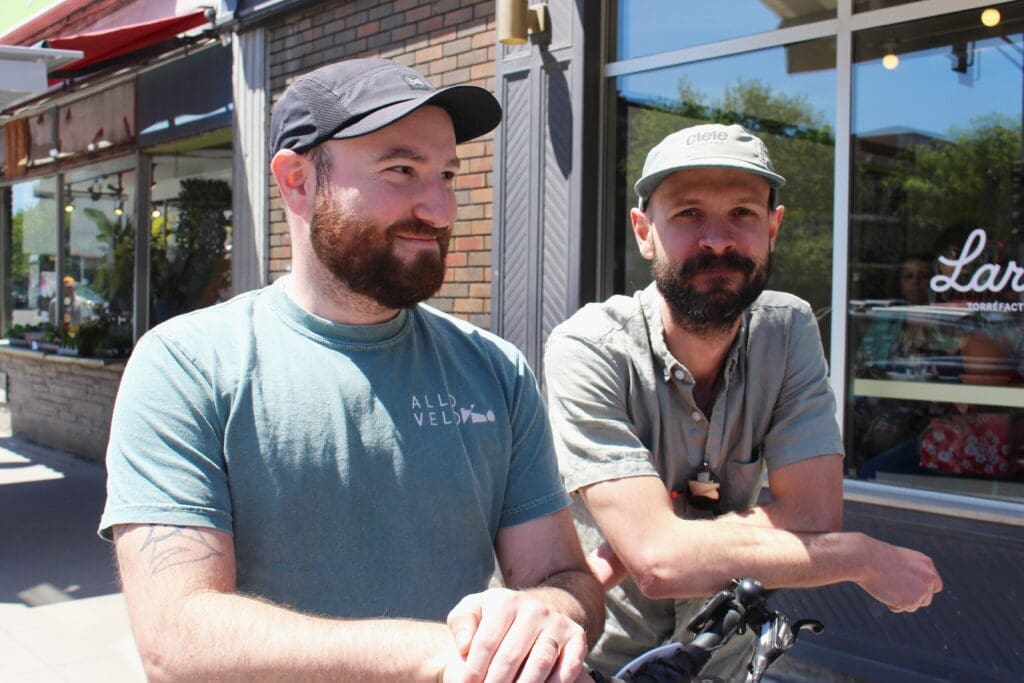
3
co-founders passionate about cycling : Michael Wexler, Louis-Philippe Tessier et Simon Vinh